
Ghost Controls Gate Repair in Montclair: A Homeowner’s Guide
Ghost Controls gate repair in Montclair usually comes down to one of three things: a solar charging circuit that isn’t actually charging, a T-harness connector that’s quietly corroded, or a dual-gate setup that’s lost sync. The fix is rarely the actuator. Most homeowners replace the battery first, then the solar panel, then the arm itself, and the gate still fails two weeks later because nobody found the connector with the green crust on pin 3. If you’d rather skip the trial-and-error, call us at (866) 371-3309 and we’ll trace the actual fault.
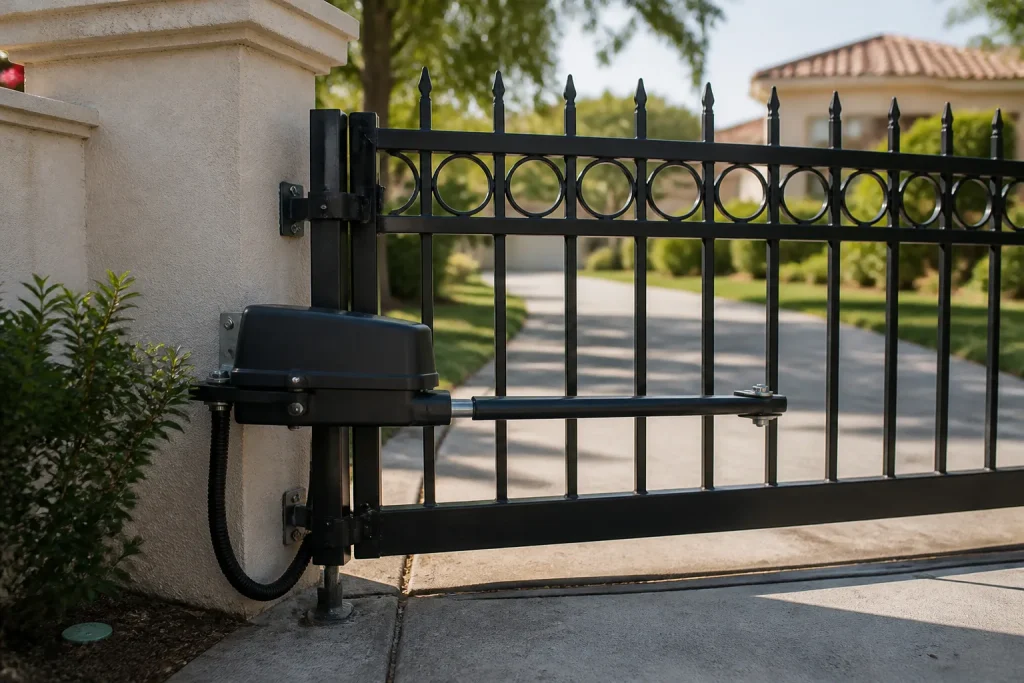
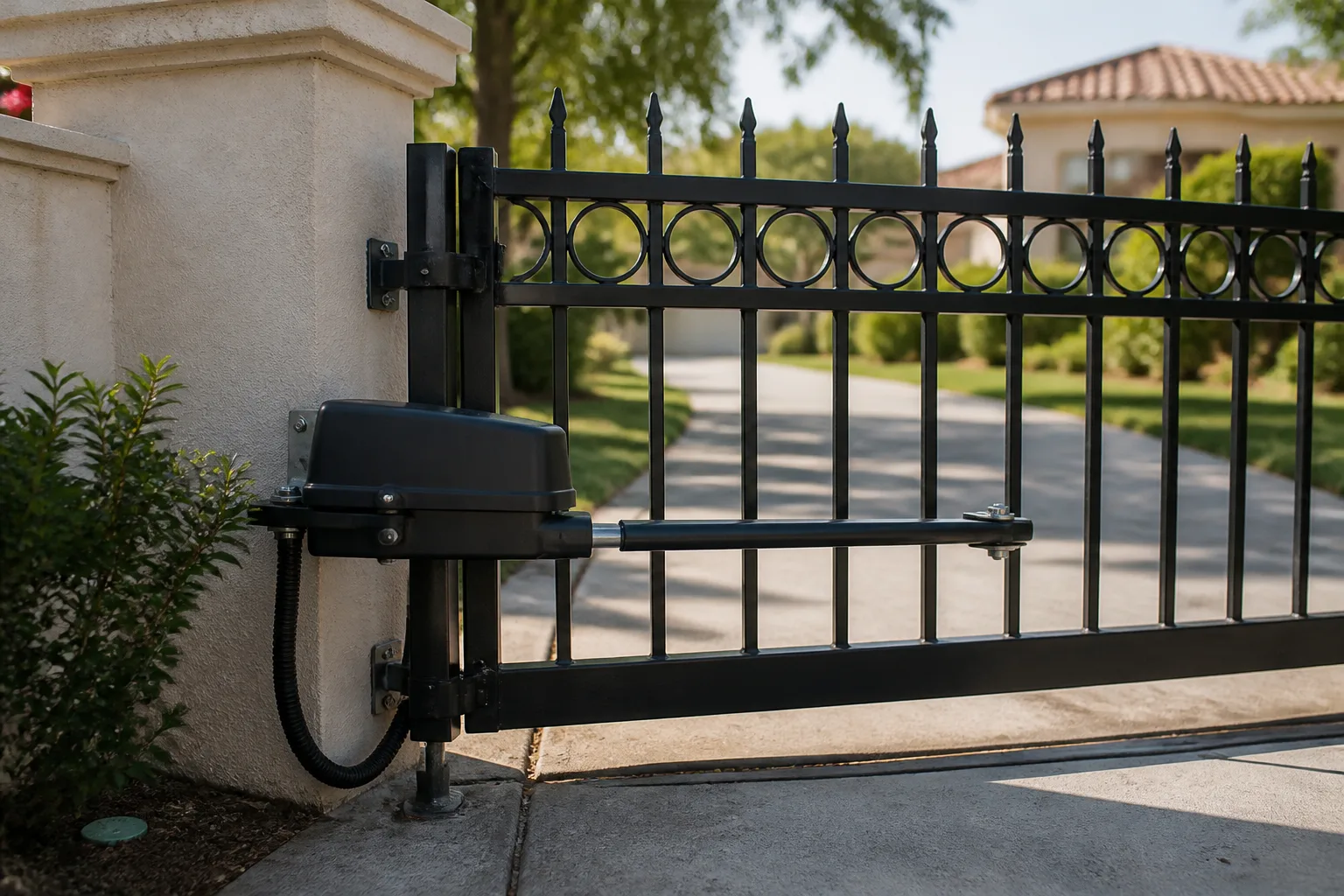
We work on Ghost Controls systems every month in Montclair, and the failure pattern is predictable once you understand how these operators are built. They’re not hardwired. They’re solar-charged, wireless, and exposed to everything the desert throws at them. That’s the appeal for rural properties in and around Sky Valley. It’s also the reason most general gate techs misdiagnose them, because they approach a Ghost Controls board the way they’d approach a LiftMaster or a Linear, and the logic doesn’t transfer.
The Failure Chain Most Techs Miss
Here’s the sequence we see on repeat in Montclair: a homeowner notices the gate moving slower than usual. Then it stops mid-cycle. Then the alarm beeps and the whole thing goes dead. They check the battery, which reads weak. They replace it. It works for two weeks and dies again. They replace the solar panel. Still dead. Then they call a general gate repair shop, and the tech swaps the actuator because that’s the expensive part, and the gate still dies. Then they call us.
The real culprit, in the majority of Ghost Controls failures we open up, is the T-harness connector where the solar panel, battery, and control board all meet. Ghost Controls uses weather-resistant connectors, but “weather-resistant” in a coastal spec doesn’t survive five years of Montclair heat, dust, and occasional monsoon moisture. The pins develop micro-corrosion that creates resistance. The board sees voltage, so it doesn’t throw an error code. But the amperage needed to actually charge the battery never gets through. The panel is fine. The battery is fine. The connection is choking the system.
On Ghost Controls support forums, you can find threads where people went through this exact sequence, part by part, over months. They’d have saved hundreds by testing the charging circuit under load instead of just probing the connector with a multimeter and seeing 12 volts. Voltage at the controller with no load doesn’t prove the panel is delivering charge. You need to test amperage, and you need to test it under the actual load of a charging battery. Most homeowners don’t own or need that equipment, but it’s the difference between a $12 connector swap and a $350 actuator replacement.
Why Dual-Gate Kits Fail Asymmetrically
If you have a double-swing gate with two Ghost Controls arm actuators, you might have noticed something strange: one side stops working while the other keeps going. The master arm opens fine, and the slave arm just sits there, or it moves halfway and gives up. That asymmetry is a Ghost Controls signature, and it confuses people because both arms share the same board, the same battery, and the same solar panel. If power were the problem, both sides would fail together.
What’s actually happening is a synchronization drift. Ghost Controls dual-gate kits communicate wirelessly between the two arms. When the slave arm’s transceiver gets weak signal, or when the arms lose their paired timing after a battery swap or a power interruption, the slave arm stops responding to commands. It’s not a motor failure. It’s a radio and timing problem. The fix is a recalibration procedure that re-syncs the two arms without wiping the remote pairings, which factory resets do. A factory reset fixes the sync issue but then dumps all your remotes and keypad codes, and now you’re reprogramming everything from scratch.
We recalibrate without the reset. It’s a specific button sequence on the board, and it preserves the arm’s memory. The arm is still programmed, the remotes still work, and the two sides move together again. This is the kind of thing that separates a Ghost Controls specialist from a general gate repair shop in Montclair. Experience with the brand means we don’t reach for the nuclear option first.
The Three Connector Points That Corrode First in Desert Climates
Every Ghost Controls installation has a handful of connection points, and in Montclair’s dry heat plus dust, three of them fail at predictable rates. You can identify them without a wiring diagram if you know where to look.
- The T-harness connector at the control board. This is the main culprit we described earlier. Look for a white or green powdery residue on the pins, or a connector that feels loose when it should click firmly. Even a millimeter of play is enough to interrupt charging.
- The solar panel quick-connect plug. Ghost Controls runs the panel feed through a weather-tight plug near the panel mount. UV light degrades the rubber gasket over a few summers. Once the gasket hardens and cracks, dust gets in, then moisture, and the pins corrode from the outside in.
- The actuator motor lead connection. The arm itself has a pigtail that connects to the main harness. It flexes every time the gate cycles. On a gate that opens and closes 20 times a day, that’s more than 7,000 flex cycles a year on a wire that’s baking in direct sun. The insulation cracks, and the connection works intermittently before it fails completely.
Any of these three points can produce the same set of symptoms: a gate that works sometimes, a battery that never seems to hold a charge, or an arm that groans and stalls. The parts themselves are inexpensive. The skill is knowing which one to open first. A tech who’s seen 50 Ghost Controls systems in Montclair opens the T-harness before anything else, because that’s where the odds point.
Testing the Solar Charging Circuit Properly
Most people check a solar panel by disconnecting it and touching a multimeter to the leads in direct sunlight. If it reads 18 or 20 volts, they call it good. That test tells you the panel is producing voltage, which is about as useful as knowing a car battery has 12 volts when it can’t crank an engine. The panel might still fail under load.
The correct test is a load test: connect the panel to a known-good battery that’s partially discharged, measure the charging current in amperes, and compare it to the panel’s rated output. A Ghost Controls 10-watt panel in full sunlight should push close to its rated current. If it’s putting out voltage but no meaningful amperage, the panel’s internal cells are damaged, or the blocking diode inside the panel junction box has failed. Either way, the panel is dead even though it “reads fine.”
The other thing to check is the charging circuit as a complete path, not just the panel by itself. Connect everything the way it runs in the field: panel, T-harness, battery, and board. Then measure the current at the battery terminals. If the panel tests good individually but the battery shows no charging current, the fault is in the harness or the connector. This is the stage where most residential gate companies give up and replace parts on a hunch. We don’t replace parts on a hunch. We trace the fault, board to loop to motor to wiring, and fix what’s actually broken.
For Montclair homeowners with skepticism about their previous repair attempts, this distinction matters. A $12 T-harness connector is a lot cheaper than a $350 actuator. When we diagnose a Ghost Controls system, we’re looking for the failed component, not the most expensive one.
Ghost Controls vs. US Automatic: Repair or Replace?
We get this question from Montclair residents who’ve had repeated problems with their Ghost Controls setup, especially on long driveways with tall or heavy gates. They want to know whether they should keep repairing what they have or switch to something like a US Automatic operator altogether.
The answer depends on the gate, not the brand. Ghost Controls operators are designed for residential, solar-powered applications with moderate gate weight and cycle counts. A single swing gate on a standard driveway, cycling 10 to 15 times a day, is well within their design envelope. Keep the connectors clean, keep the panel angled right, and the system runs for years. When the failure is just a connector or a sync issue, repairing in place is the obvious call. The operator isn’t wrong for the job; a component just wore out.
But if the gate itself is heavy, solid steel, long, or cycles constantly, there’s a point where the Ghost Controls actuator is working beyond its intended duty cycle. A US Automatic operator is built for heavier, more frequent cycles. It’s a different class of machine. In those cases, we tell homeowners straight: you can keep replacing arms every two years, or you can install an operator that matches the load. We’re not loyal to any one brand for its own sake. We repair Ghost Controls, and we also repair and install US Automatic, DoorKing, Linear, and Viking. The right recommendation depends on what’s hanging on the hinges and how many times a day it swings.
When repair is the right call, we say so. When replacement makes more sense over three years of ownership costs, we say that too, and we give you a written price either way before any work starts. You’ll know the number before you approve anything. That’s not a policy we advertise with slogans; it’s just how a repair shop should operate.
What a Ghost Controls Specialist in Montclair Does Differently
General gate repair shops in the Montclair area fix a lot of brands, and many of them do honest work. But Ghost Controls is its own ecosystem. It’s solar-first, wireless, DIY-install-friendly, and built around modular components. A tech who mostly sees commercial operators like DoorKing or FAAC boards approaches the problem with different instincts. They look for line voltage, contactors, and limit switches. None of those exist on a Ghost Controls residential system.
A Montclair tech who specializes in Ghost Controls knows the failure chain before they arrive. They test the charging circuit under load, not just voltage. They know which connector to open first. They know the recalibration sequence that fixes a sync issue without dumping remote pairings. And they know which Ghost Controls components are still under warranty, because Ghost Controls warrants their actuators and boards for 18 months from purchase for residential use. That matters. A warranty-covered board replacement is free to the homeowner, but only if the tech who opens the box knows how to verify the warranty status and file the claim correctly. We handle that for Montclair customers because we see enough Ghost Controls hardware to stay fluent in the process.
We work on your brand. That’s the whole point. We don’t ask you to adapt to what we know; we already know the operator on your gate. From a bent arm to a full installation, the same specialist handles it start to finish, whether it’s a Ghost Controls actuator on a ranch driveway or a DoorKing operator on a multi-tenant property. If you’re in Montclair and your gate is down, no matter what brand it is, you don’t need to shop around Montclair Gate Repair home to find someone who’s seen it before. Nine brands. One call.
When to Call a Pro
Some Ghost Controls maintenance is owner-friendly: wiping down the solar panel, trimming back the lantana that’s shading it, tightening the occasional mount bolt. But when the gate stops mid-cycle, beeps, or moves on one side only, the safe and honest advice is to stop guessing. The system involves a charging circuit, a wireless sync network, and a moving gate that can hurt someone if it behaves unpredictably. A gate that fails partway through its arc can drift closed with enough force to injure a person or damage a vehicle. That’s not a reason to panic; it’s a reason to get the problem diagnosed correctly the first time.
If you’ve already replaced the battery and the problem came back, you have your answer: the battery was never the problem. Call (866) 371-3309 and let us find what actually is. If your gate is down and you’re in Montclair, you’re a short drive from Gate Repair in Sky Valley, and we cover that area regularly. For gates that have failed at the electrical level, Electric Gate Repair in Sky Valley is the service page that describes our diagnostic approach in detail. And if you’ve decided the operator isn’t worth saving, Gate Installation in Sky Valley covers full replacements.
The Bottom Line
Ghost Controls gate repair in Montclair succeeds or fails on the diagnosis. The systems are reliable when installed correctly and maintained with attention to the solar charging path. The most common failure is not the actuator or the battery; it’s a connector or a lost sync. A tech who knows the brand fixes it in an hour without unnecessary parts, and a tech who doesn’t burns through your money one wrong guess at a time.
If you’re in Montclair and need help, Montclair Gate Repair offers free estimates. Call (866) 371-3309, and we’ll come out, test the charging circuit properly, open the connectors in the right order, and tell you what’s actually wrong. Every quote is agreed in writing before any work starts, so the price you approve is the price you pay.
Frequently Asked Questions
Intermittent operation in a Ghost Controls system almost always points to a partial connection failure, not a dead component. The T-harness connector, the solar panel quick-connect, or the actuator pigtail has developed enough resistance to work sometimes and fail under load other times. A battery that’s borderline or a panel that’s partially shaded can also cause intermittent gremlins. We test the full charging path under load to identify which one it is. Call (866) 371-3309 and we’ll find the fault without throwing parts at it.
You can, and Ghost Controls designs for that DIY market. But before you buy a new arm, make sure the arm is actually the failure. We see a lot of Ghost Controls actuators get replaced in Montclair when the real fault was a $12 connector or a sync drift. If you’ve confirmed the arm itself is dead, the physical swap is straightforward. If you’d rather have it done right the first time, call (866) 371-3309 for a free estimate.
The cost depends on the failed component, which is why diagnosis matters. Here’s what Montclair homeowners typically see for Ghost Controls repairs:
- Diagnostic service call: $75 – $125, often applied toward the repair if you proceed.
- T-harness connector replacement: $40 – $85 including the part and labor.
- Solar panel replacement: $120 – $220 depending on wattage and mounting.
- Actuator arm replacement: $280 – $450 per arm depending on the model.
- Control board replacement: $150 – $300 depending on warranty status.
Every price is quoted and agreed before any work starts. Call (866) 371-3309 for an exact quote on your system, and mention the Ghost Controls model number if you can find it on the arm.
Ghost Controls covers the defective component for 18 months on residential installations, but the warranty covers parts, not labor. The labor to install the replacement is on the homeowner. That said, we verify warranty status before you pay for a part that should be free, and we file the claim paperwork for Montclair customers. A board that fails at 14 months shouldn’t cost you $200 if the manufacturer will replace it. Call (866) 371-3309 and we’ll check your date of purchase before we quote the repair.
Written by the team at Montclair Gate Repair, serving Montclair since 2013.
Need Gate Repair Help?
Call Montclair Gate Repair — licensed & insured, here with fast after-hours help in Montclair.
(866) 371-3309